

Binho Nova
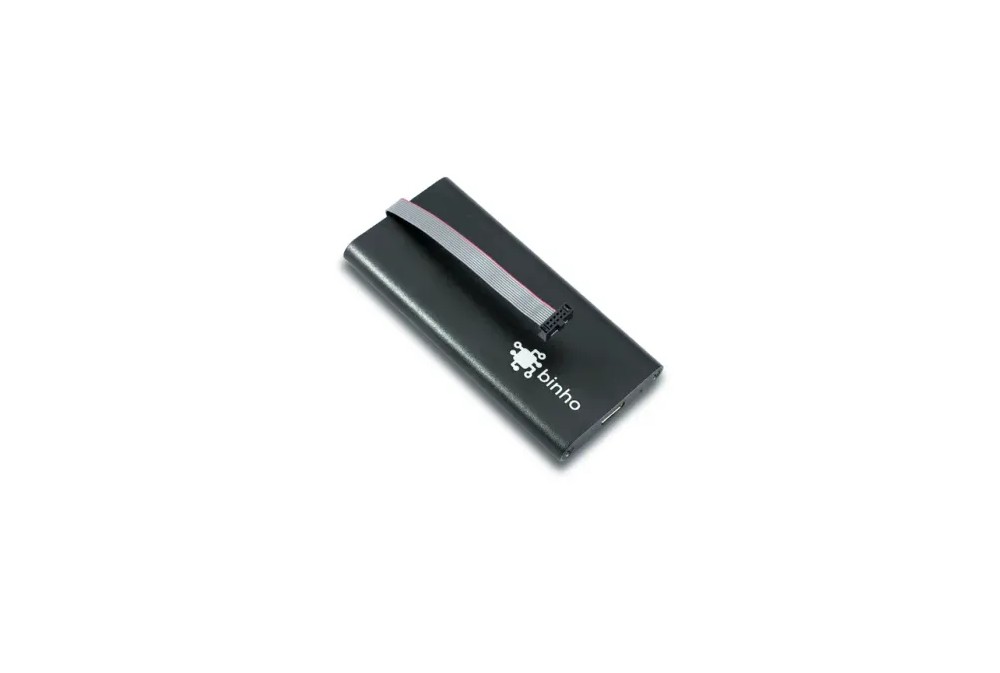
Binho Nova host adapter.
In this guide: Setup · Hardware reference · Protocols · Firmware · FAQ · Troubleshooting
Summary
Section titled “Summary”The Nova connects the computer to I2C, SPI, UART and 1-Wire devices at 3.3 V. It is powered from USB and can power a small target from its 3V3 and VUSB pins.
It has 5 signal pins. Each pin can be a digital input or output, a PWM output, an interrupt input (rising, falling or both edges), an analog input, or the analog output. While a bus uses some pins, the remaining pins keep their other functions, for example as chip selects or interrupts.
Typical uses: firmware development, driver bring-up, automated hardware and firmware tests, and EEPROM, Flash or FRAM programming.
Choose the Right Adapter
Section titled “Choose the Right Adapter”| Need | Adapter |
|---|---|
| One protocol at a time, 3.3 V logic, USB Full Speed | Nova |
| Logic levels from 1.2 V to 3.3 V, target modes, RS-485, CAN-FD, USB High Speed | Pulsar |
| I3C (SDR, HDR-DDR, 0.8–3.3 V), alongside I2C, SPI and UART | Supernova |
To compare it with the current adapters, see the Hardware Comparison Table.
Software
Section titled “Software”| Software | Use it for | Get it |
|---|---|---|
| Mission Control 2 | Click-driven transactions, no code | Mission Control 2, latest release 2.17.5 |
Nova SDK (binho package) | Scripts, test automation, binho command line | pip install binho (PyPI), see Nova SDK |
The older binho-host-adapter package (0.1.6, 2020) still installs, but new scripts should use binho.
In the Box
Section titled “In the Box”- Binho Nova USB host adapter
- Breadboard breakout adapter
- USB Type-C to Type-A cable, 1 foot
- Soft-shell zippered case
ASCII Command Set
Section titled “ASCII Command Set”Nova’s native command protocol is human-readable and driveable straight from a serial terminal: useful for debugging, evaluation, and proof-of-concept work without writing any code. Nova implements this command set in full; Supernova and Pulsar emulate a subset of it in Nova Compatibility Mode. The shared reference is here: