
Binho Atira
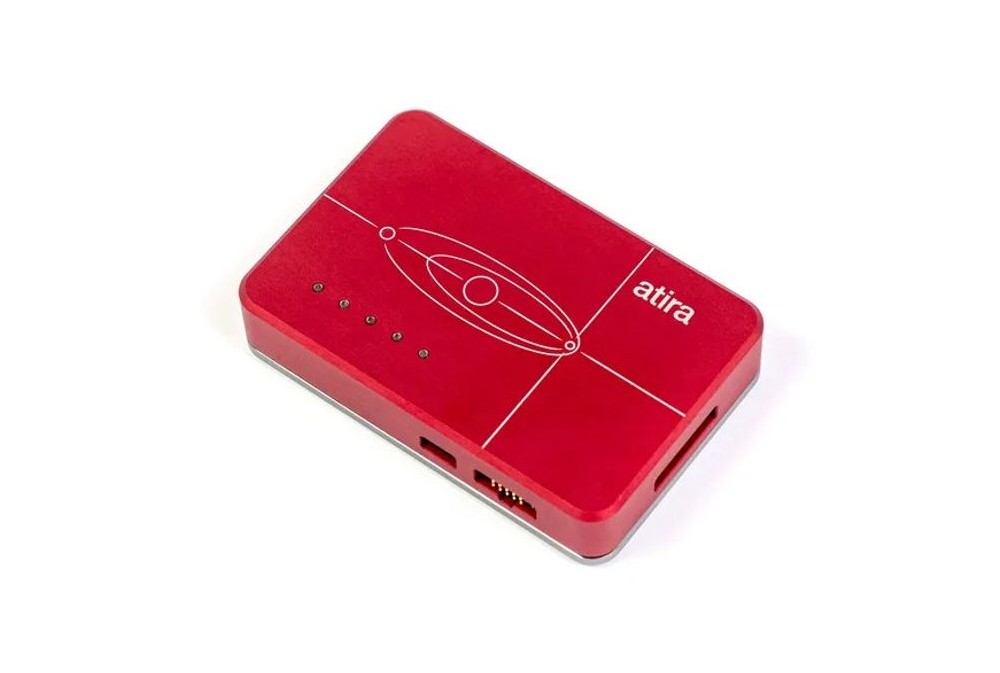
Binho Atira.
In this guide: Setup · Hardware reference · Protocols · Firmware · FAQ · Troubleshooting
Summary
Section titled “Summary”The Binho Atira is an embedded bridge for Arm Cortex-M development. It connects a computer to the target over USB and provides:
- SWD debug: attach, halt, run, step, read and write registers and memory, hardware breakpoints.
- Target flashing: the Atira is CMSIS-DAP compatible, so stock pyOCD programs the target’s internal flash.
- Target power: a programmable 1.2 to 5.0 V rail for the target, with voltage, current and power readings.
- SPI controller and SPI flash programming: detect, erase, program and verify an external SPI memory device.
- USB-to-UART bridge: appears as two serial ports on the computer: one to talk to the target, and a second, read-only port that mirrors the traffic for observation.
Software Support
Section titled “Software Support”| Software | What it does |
|---|---|
| Mission Control 3 | MCU Programmer and MCU Debugger: flash, verify, erase, halt, step and set breakpoints with no code. Desktop app for Windows, macOS and Linux. See Install a device pack |
| PyCosmicSDK | Python SDK: pip install pycosmicsdk. Power, SWD debug, SPI, SPI flash and the UART bridge port, with blocking and asyncio APIs |
| CosmicSDK | C and C++ SDK, the library under PyCosmicSDK |
| pyOCD | Program, erase and read back the target’s internal flash |
| dfu.binho.io | Firmware update in the browser. See Updating Firmware |
Full Python API: PyCosmicSDK guide for the Atira. C and C++: CosmicSDK guide for the Atira.